Power Blouses for Virtual Meetings: What Actually Reads on Camera
The most important conclusion first: the blouse that looks sharp in your mirror often looks flat, washed out, or distracting on a 720p webcam. What reads as “polished” on screen depends less on brand name and more on three things: collar structure, fabric weight, and color contrast against your background. A $28 blouse with a defined collar beats a $180 silk shell every time on camera.
This is not a list of “cute tops for Zoom.” It is a breakdown of six specific power blouse styles that hold up under compressed video, with the fabric weights, collar shapes, and colors that actually matter when your shoulders and collarbone are the only parts of you visible.
Why Most Blouses Fail on Camera
The fundamental problem with virtual meeting attire is that webcams compress everything. Fine details disappear. Thin fabrics go translucent under ring lights. Busy prints create a moiré effect that flickers on your colleagues’ screens. Most blouses are designed for in-person viewing, where someone sees the full garment and the fabric moves naturally. On camera, you get a static, head-and-shoulders crop at roughly 480p to 720p resolution.
What actually matters on camera:
- Collar geometry — a defined collar frames your face. A collarless blouse leaves your neck and shoulders as an unbroken block of fabric.
- Fabric weight — anything under 120 grams per square meter (gsm) will look limp and rumpled. You want 130 to 180 gsm for visible structure.
- Color contrast — if your blouse is within two shades of your wall color, you disappear. If it is the same tone as your skin, you look washed out.
- Pattern scale — prints smaller than a quarter read as visual noise. Prints larger than your palm read as a costume.
This is why the most common mistake is buying a “nice blouse” based on how it looks on a hanger or in a mirror, then discovering it does nothing on screen. The camera does not care about the price tag. It cares about contrast and structure.
Six Power Blouse Styles That Survive the Webcam
Each of these styles earns its place because it solves a specific camera problem. The recommendation is concrete, not a vague “consider your options.”
1. The Structured Poplin Shirt — Everlane The Poplin Shirt ($68)
Poplin is a plain-weave cotton with a tight, flat surface. It holds a crease, resists wrinkling during a 45-minute call, and has enough stiffness to keep a collar standing. Everlane’s version uses 100% organic cotton at approximately 140 gsm, which is heavy enough to avoid the see-through problem under a ring light but light enough to wear in a warm home office. The collar is a standard point collar with removable stays. On camera, this reads as crisp and intentional, even if you have been wearing it since 8 a.m.
Verdict: The best all-purpose power blouse for virtual meetings. White or light blue poplin gives maximum contrast against most backgrounds. Skip the black version — it reads as a silhouette and hides the collar detail that makes the blouse work.
2. The High-Neck Shell — COS Clean-Cut Wool-Blend Top ($89)
For people who find collars uncomfortable, the high-neck shell is the alternative that still frames the face. COS makes a wool-blend version with a wide, folded neckline that sits just below the collarbone. The fabric is a 70% wool, 30% polyester blend at roughly 200 gsm, which gives it enough body to hold its shape without a collar. The key is the neckline width: too narrow looks like a crewneck t-shirt; too wide looks like a boatneck and slides off the shoulders. This one sits in the middle.
Verdict: The best choice for long meeting days when comfort matters but you still need to look deliberate. Choose a saturated color — the rust or forest green versions — because the lack of collar means you need color to create the visual structure.
3. The Contrast-Trim Blouse — M.M.LaFleur The Morris Blouse ($145)
M.M.LaFleur designs specifically for professional women who sit on camera. The Morris blouse has a notched collar with a contrasting trim along the lapel edge. That contrast line is the entire point: it creates a crisp boundary between the blouse and your skin, which survives video compression far better than tone-on-tone detailing. The fabric is a Japanese crepe at 160 gsm with a matte finish, which means no glare from a ring light.
Verdict: The best option when you want visual interest without a print. The contrast trim does the work that a pattern would do, but without the moiré risk. The navy-with-white-trim version is the most versatile.
4. The Stand-Collar Blouse — Uniqlo Rayon Long-Sleeve Blouse ($39.90)
A stand collar, sometimes called a mandarin collar, rises vertically from the neckline instead of folding over. This creates a strong vertical line on camera, which elongates the neck and frames the jawline. Uniqlo’s rayon version is lighter than the other options — around 120 gsm — but the collar structure compensates for the lighter fabric. Rayon drapes smoothly and does not wrinkle easily, which matters when you are sitting for hours.
Verdict: The best budget option. At under $40, it delivers the on-camera structure of blouses costing three times as much. The tradeoff is durability: rayon pills faster than cotton poplin. Expect one to two years of regular wear before it looks tired.
5. The Darted Wrap Blouse — Quince Washable Silk Wrap Blouse ($59.90)
Wrap blouses are tricky on camera because the V-neck can plunge too low for a professional frame. Quince’s version solves this with a modest wrap depth — the V ends about four inches below the collarbone — and a hidden snap at the crossover point. The fabric is a washable silk at 19 momme (approximately 150 gsm), which gives it weight and a subtle sheen that reads as “expensive” rather than “shiny” on video. The darts at the waist matter less on camera, but they matter when you stand up.
Verdict: The best choice when you want to look polished without looking stiff. The wrap silhouette softens the shoulders, which is flattering if you have a broader frame. Avoid white — the silk sheen plus white reads as overexposed under bright lighting.
6. The Utility Pocket Blouse — Madewell Oversized Pocket Shirt ($78)
Utility blouses borrow from workwear: chest pockets, reinforced seams, and a boxier cut. Madewell’s version uses a cotton-linen blend at roughly 150 gsm with two chest pockets and a button-front placket. On camera, the pockets and placket create horizontal and vertical lines that give the eye something to track. This matters because a plain, unbroken fabric surface can look like a blob on low-resolution video. The linen content means it wrinkles, but the wrinkles read as “casually professional” rather than “sloppy” — a fine line that works for creative industries and startup culture.
Verdict: The best choice for casual or creative workplaces where a starched poplin shirt would look out of place. Pair it with a visible necklace to add another visual anchor point.
Fabric Weight and Camera Behavior: The Numbers
Fabric weight is the most under-discussed variable in virtual meeting style. Here is how different weights behave on a standard 720p webcam with typical home lighting:
| Fabric Weight | On-Camera Behavior | Best Use | Example Blouse |
|---|---|---|---|
| Under 120 gsm | Limp, shows every wrinkle, can go translucent under ring lights | Avoid for important calls | Cheap polyester shells |
| 120–140 gsm | Acceptable if the collar has structure; drapes well but may need steaming | Internal meetings, casual Fridays | Uniqlo Rayon Blouse ($39.90) |
| 140–170 gsm | Holds shape, resists wrinkles for an hour, reads as crisp and deliberate | Client calls, interviews, presentations | Everlane Poplin Shirt ($68), Madewell Pocket Shirt ($78) |
| 170–200+ gsm | Strong structure, may look heavy or stiff on camera, can read as outerwear | Cold offices, formal settings | COS Wool-Blend Top ($89) |
The sweet spot for most people is 140 to 170 gsm. Below that, you are fighting wrinkles and translucency. Above that, the blouse starts to look like a jacket. This is not a hard rule — collar construction can compensate for lighter fabric — but it is a reliable starting point when shopping online and checking product descriptions.
The Color Problem No One Talks About
Color contrast is the single biggest lever you can pull to improve your on-camera presence, and almost no one thinks about it. The rule is simple: your blouse should be at least two to three shades lighter or darker than your background and your skin tone.
White blouses are the default choice for a reason. They create maximum contrast against most backgrounds and against most skin tones. But white has a failure mode: under a direct ring light, pure white can bloom and lose all detail. If you wear white, choose an off-white, ivory, or warm white instead of optic white. The slight warmth prevents the overexposure problem.
Black is the opposite failure mode. A black blouse against a dark wall or bookshelf makes you disappear. If you wear black, you need a light background or a visible necklace to create separation. Most people are better off with navy, charcoal, or deep green, which read as dark but retain some color information on camera.
Jewel tones — burgundy, emerald, sapphire, mustard — are the most reliable on-camera colors. They are saturated enough to create contrast against both light and dark backgrounds, and they flatter a wider range of skin tones than pastels, which tend to wash out on video. If you buy one new blouse for virtual meetings, make it a jewel tone.
Mistakes That Make a Good Blouse Look Bad on Screen
Four specific failure modes show up repeatedly, even with expensive blouses. These are the things to check before you buy and before you join a call.
Buying a blouse with no collar definition
A collarless blouse with a plain round neckline leaves your face floating above an unbroken expanse of fabric. On camera, this looks unfinished. The fix is either a visible collar, a stand collar, a contrast trim, or a necklace that creates a V-shape. If the blouse has none of these, it is not a power blouse for video purposes.
Choosing a print that moirés
Any print with repeating lines or a tight geometric pattern can create a moiré effect — a shimmering, moving pattern that appears on video even though the fabric looks fine in person. This is a physics problem with digital video compression, not a style problem. The fix is simple: avoid prints with lines closer than roughly a quarter inch apart. Larger, irregular prints are safer. Solid colors are safest.
Ignoring the shoulder seam
On camera, your shoulders are one of the few parts of your body that are always visible. If the shoulder seam sits too far down your arm, the blouse looks oversized and sloppy. If it sits too high, the blouse looks tight and uncomfortable. The seam should sit exactly at the edge of your shoulder bone. This is a fit issue that tailoring can fix for $15 to $25, and it is the cheapest upgrade you can make to any blouse.
Forgetting the back of the blouse
You will stand up at some point during the workday, even if it is just to get coffee. A blouse that looks great from the front but gapes, pulls, or wrinkles across the back will undermine your confidence. When trying on a blouse, check the back in a mirror. If the fabric pulls across the shoulder blades, size up or choose a different cut.
When Not to Buy a Power Blouse
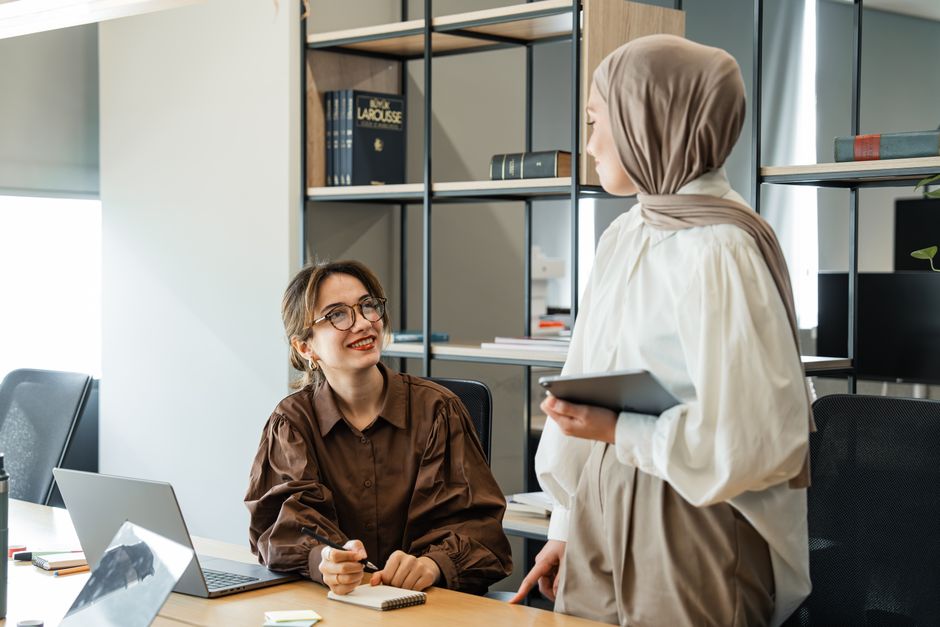
There are situations where a power blouse is the wrong purchase. If your workplace is fully camera-off, spending money on on-camera clothing is not a priority. If your role involves physical work — lab work, warehouse supervision, anything where you move constantly — a structured blouse will wrinkle and restrict movement. In those cases, a high-quality knit top with a defined neckline, like the Quince Mongolian Cashmere Crewneck ($59.90) or the Uniqlo 3D Knit Crew Neck ($39.90), is the better choice.
Similarly, if you live in a hot climate without air conditioning, heavy cotton poplin and wool blends will be uncomfortable. The Uniqlo AIRism Cotton Blouse ($29.90) is a lighter alternative that still has a collar, though it sacrifices some structure. The tradeoff is real: lighter fabric means more wrinkles and less on-camera presence. You have to decide which matters more.
The underlying principle is that a power blouse is a tool, not a status symbol. It solves a specific problem: how to look deliberate and competent in a medium that flattens everything. If that problem does not exist for you, the tool is unnecessary.